
Henderson County Court Records After Arrest
After a Henderson County jail arrest, the record trail splits. The Henderson County Sheriff's Office and its official custody channels show whether a person was booked into the Henderson County Detention Center, whether the person is in current confinement, and which arresting agency appears in the jail data. The formal case is different. Court records after a jail arrest belong to the North Carolina Judicial Branch and the Henderson County Clerk of Superior Court. Those records show the filed criminal case, charge wording, hearings, court dates, and disposition when the case reaches an outcome.
The distinction matters because a booking charge is not always the final court charge. A person arrested by the Sheriff's Office, Hendersonville Police Department, Fletcher Police Department, Laurel Park Police Department, N.C. Highway Patrol, or another agency may first appear in app or Citizen Connect custody tools. The District Attorney for Prosecutorial District 42 then reviews the case for prosecution. For custody and booking detail, use Henderson County jail inmate records. For booking-photo limits, use Henderson County jail roster mugshots. Court records after an arrest should be checked through eCourts and the Clerk.
Find Court Records After Jail Arrest
The main public case path is the North Carolina eCourts Portal. Smart Search lets a user search by record number or by a party name in last, first format, then narrow results with location, party, and case filters. For Henderson County court records after a jail arrest, choose Henderson County when the location filter is available. If a case is not visible, the next local source is the Henderson County court contact directory and the Clerk of Superior Court.
| eCourts Smart Search Field | How It Helps After Arrest |
|---|---|
| Record number or name | Search by case number if known, or by defendant name in last, first middle format. |
| Filter by location | Narrows statewide results to Henderson County court records. |
| Party criteria | Uses name, date of birth range, gender, ethnicity, phone, FBI number, SO number, or booking number filters when available. |
| Case type and case status | Separates criminal cases from other court records and helps identify pending or closed matters. |
| File date start and end | Helps locate new charges filed after a recent jail arrest. |
Search Hearings is the second eCourts tool to check. It can be filtered by Henderson County, hearing type, party name, case number, attorney, judicial officer, or courtroom. Use Criminal as the hearing type when the search concerns court records after an arrest. A hearing listing is not the same as a full case file, but it can confirm the next appearance and help connect the jail arrest to the right case number.
| eCourts Hearing Field | Use for Henderson County Arrest Cases |
|---|---|
| Select Location | Choose Henderson County when searching local criminal hearings. |
| Select Hearing Types | Choose Criminal for hearings tied to jail arrest charges. |
| Select Search Types | Search by case number, party name, attorney, judicial officer, or courtroom. |
| Sounds Like | Use when the spelling of a last name or first name may vary. |
| Last, first, and middle name | Use party-name fields when no case number is known yet. |
The manifest includes a successful courthouse capture from the North Carolina Judicial Branch Henderson County Courthouse page, which lists the local courthouse information used for Clerk routing.
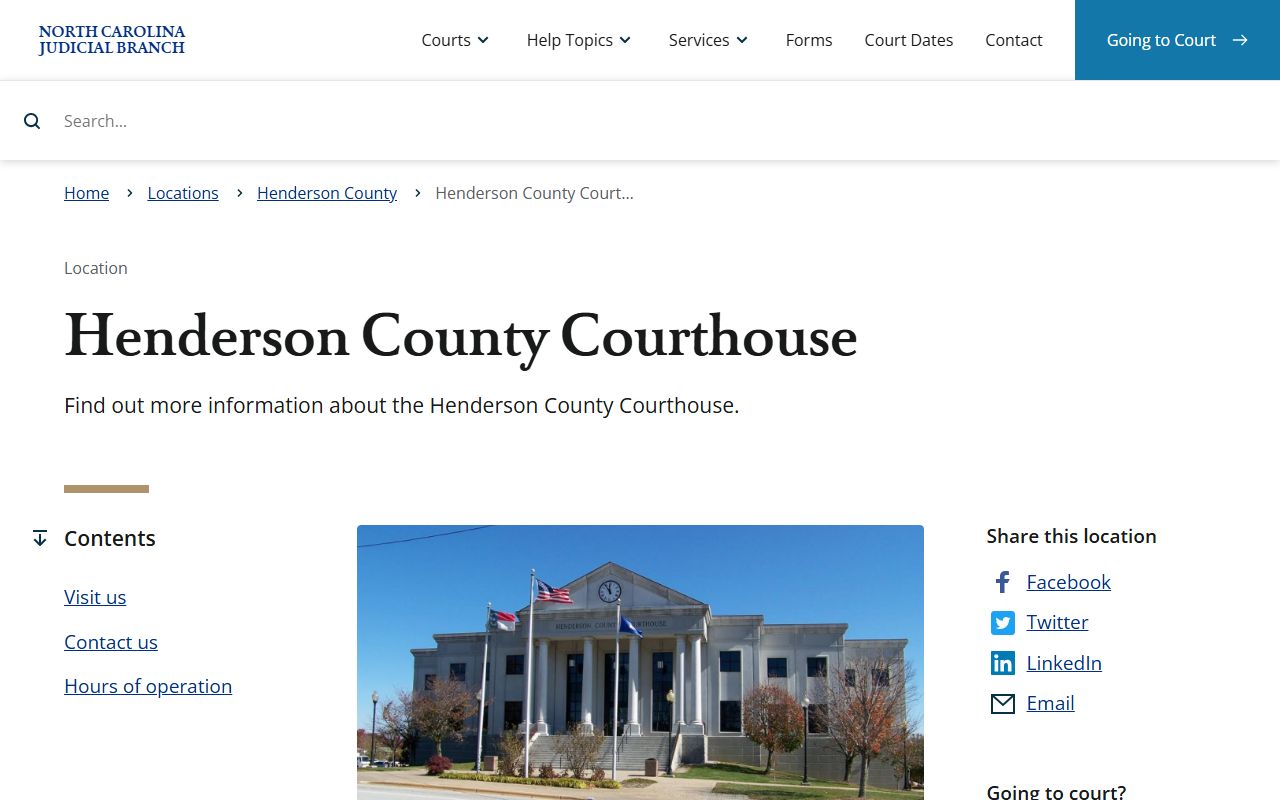
Use the courthouse page and eCourts together: the portal is the search tool, while the Clerk is the local office for older, restricted, or unavailable court records.
Arrest to Henderson County Court Case
The practical sequence is arrest, transport, booking, first appearance, prosecutor review, then a filed court case. Henderson County's detention-center page notes a secure transfer path between the detention center and the courthouse, so court movement happens inside the public-safety and courthouse complex rather than through a public sidewalk route. The court record, though, is not made by the jail. It starts when the charge is filed or processed through the court system.
- Confirm the person was booked through the HCSO mobile app or Citizen Connect Inmate Confinements.
- Note the arresting agency and any charge words shown in the jail channel.
- Open eCourts Smart Search and search by defendant name or case number.
- Filter to Henderson County and open the matching criminal case.
- Use Search Hearings for the next court date when the case record or notice is unclear.
- Contact the Clerk if the case is old, restricted, sealed, expunged, or not visible online.
Do not treat a jail charge as the final result. The prosecutor can add, dismiss, amend, reduce, or supersede charges. A felony may begin in District Court and later move toward indictment or Superior Court. The District Attorney for Prosecutorial District 42 handles prosecution for Henderson County, Polk County, and Transylvania County.
Arrest Records and Charging Documents
Charging papers explain why court records after a jail arrest may not match the first jail entry. A booking can begin with officer paperwork, a warrant, a magistrate process, or a court order. After review, the prosecutor may file or proceed on a different charge form. North Carolina felony matters may later involve grand-jury action, while many misdemeanor and early felony steps appear in District Court first.
| Document | Who Uses It | Role in the Case |
|---|---|---|
| Complaint or warrant paperwork | Officer, magistrate, or prosecutor | Begins the arrest or initial charging process and may support the first appearance. |
| Information or prosecutor filing | District Attorney | States the charge the prosecutor is pursuing in court after review. |
| Indictment | Grand jury and prosecutor | Moves or supersedes a felony charge for Superior Court prosecution. |
Henderson County Charge Status Records
Charge status is the part of the court record that shows where the allegation stands. A pending charge means the case has not reached a final result. A dismissed charge is not a conviction. An amended or reduced charge means the original wording changed. A superseding indictment can replace earlier charge language. These changes are a normal reason that court records after an arrest should be checked in eCourts rather than only in the jail roster.
| Status | Plain Meaning |
|---|---|
| Pending | The case is still open and no final court result has been entered. |
| Amended or reduced | The filed charge changed, often after prosecutor review, plea talks, or court action. |
| Dismissed | The charge was ended without a conviction on that charge. |
| Superseding indictment | A later indictment replaced earlier charge wording or added a new charging basis. |
| Disposition | The final result, such as conviction, dismissal, not guilty, plea, or other court outcome. |
| Expunction | An eligible record was removed from public clerk files by court order under North Carolina law. |
Bond Holds and Court Records
Bond information can change after first appearance, a new warrant, a probation or parole hold, a court order, or a detainer from another agency. Henderson County's official jail pages did not publish a detailed bond-payment fee schedule in the research. The safer path is to confirm custody through the HCSO app or Citizen Connect, call the Henderson County Detention Center at 828-694-3091 for current release instructions, then check eCourts or the Clerk for formal charge and court-date status.
| Release Term | How It Works |
|---|---|
| Written promise or PR release | Release based on a promise to appear, without upfront payment. |
| Unsecured bond | No upfront payment, but money may be owed if court conditions are broken. |
| Secured or cash bond | Money, property, or a surety must be posted before release. |
| Surety bond | A licensed bail agent posts bond for a fee or collateral arrangement. |
| No-bond hold | Release is blocked unless a court or holding agency changes the condition. |
Citizen Connect's agency list includes court, DOC, probation or parole, U.S. Marshals, ICE, Department of Homeland Security, other counties, and bonding-company values. That means a person may have a Henderson County bond and still not be released if another hold remains. The NC eCourts payment tool is for some court payments, probation, parole, criminal, and infraction cases. It should not be treated as the Henderson County jail bond portal unless the jail or court gives that instruction.
Warrants After Henderson County Arrest
No official Henderson County active-warrant search page was found in the researched sheriff sources. That absence does not mean no warrant exists. If a warrant has been served and the person was booked, the first public sign may be the HCSO app, Citizen Connect current confinements, or the Daily Report booking view. If the issue is tied to court, eCourts Smart Search and Search Hearings are better places to look for failure-to-appear events, bench warrants, or hearing dates.
For local warrant and court-routing questions, use official contacts. The Clerk of Superior Court is listed at 828-694-4100. Magistrates are listed at 828-694-4250. The Sheriff's Office administration number is 828-697-4596, detention is 828-694-3091, and records is 828-694-3128. For a federal warrant or federal pretrial custody question, Henderson County is covered by the U.S. Marshals Service Western District of North Carolina, including the Asheville office at 828-771-7400.
Court Charges Versus Convictions
An arrest is not a conviction, and a filed charge is still an accusation until the court reaches a result. Henderson County court records after a jail arrest may show a person was charged, had bond set, attended hearings, or had the case dismissed. A conviction requires a guilty plea, verdict, or other court judgment that resolves the charge as a conviction.
| Point of Comparison | Charge | Conviction |
|---|---|---|
| Meaning | An accusation filed or pursued in court. | A final finding or plea that results in guilt on a charge. |
| Timing | Appears after arrest, warrant service, citation, prosecutor filing, or indictment. | Appears after plea, verdict, or other judgment. |
| Can change | Yes. It may be amended, reduced, dismissed, or superseded. | Can be appealed or later affected by expunction if eligible. |
| Lookup source | eCourts, Clerk records, and sometimes jail booking context. | eCourts, Clerk records, and NCDAC if a prison or supervision sentence follows. |
Sealed or Expunged Arrest Court Records
North Carolina law separates public access from confidentiality. G.S. 132-1 defines public records broadly, but not every court or law-enforcement record remains public in every setting. For criminal cases, G.S. 15A-145.5 covers expunction eligibility for certain misdemeanors and felonies, and G.S. 15A-151 makes expunged court records confidential in clerk files. Eligibility depends on the charge, disposition, prior record, waiting period, and court order.
| Record Treatment | What It Means | Where to Ask |
|---|---|---|
| Public | The record can generally be inspected through normal court or public-record channels. | eCourts, Clerk of Superior Court, or the proper records custodian. |
| Restricted or sealed | Public access is limited by rule, order, age of case, record type, or confidentiality law. | Clerk of Superior Court or the court that controls the file. |
| Expunged | An eligible record is made confidential in clerk files after a court grants expunction. | Clerk of Superior Court and legal counsel for eligibility questions. |
Public Records and Arrest Expunction
North Carolina public-records law supports access to many records made or received by public agencies in the course of public business. The G.S. 132-1 public-records definition is the starting point. G.S. 132-6.2 addresses public-record copy fees and says agencies are not required to create or compile records that do not exist. For court records after an arrest, the right custodian is often the Judicial Branch or Clerk. For sheriff booking records, the custodian is the Sheriff's Office.
The Judicial Branch public-record request guidance is used for Judicial Branch records, while county or city records must be requested from the local office that keeps them. Henderson County Sheriff's Office routine incident reports can be requested through Records at 100 North Grove Street, and the research notes no charge for an incident-report copy. Public-information or FOIA requests submitted to HCSO are overseen by the Public Information Officer, Stephanie Barbosa, through the sheriff's public-information channel.
Important: This private site is not an FCRA consumer reporting agency, and its information cannot be used for credit, employment, tenant, insurance, or similar screening.
Henderson County Court Arrest Contacts
Different records sit with different offices. The jail confirms custody. The Clerk and eCourts show the criminal case. The District Attorney prosecutes the case. NCDAC, BOP, USMS, and ICE handle state, federal, and immigration custody after transfer or detainer issues. Use the contact that matches the record, because one office may not control another office's files.
Henderson County Courthouse and Clerk of Superior Court
200 N Grove St, Suite 163
Hendersonville, NC 28792
828-694-4100
Monday-Friday, 8:30 a.m.-5:00 p.m.
District Attorney, Prosecutorial District 42
Henderson County Courthouse
200 N Grove St, Suite 163
Hendersonville, NC 28792
828-694-4200
Henderson County Detention Center
375 First Avenue East
Hendersonville, NC 28792
828-694-3091
Public Record Search
Sponsored Results